UAE Remote Work Visa: The Truth About Tax-Free Living in 2026
The UAE introduced a 9% corporate tax in 2023. What does that mean for digital nomads? Here's the complete breakdown.

I spent 14 months in the UAE between Dubai and Ras Al Khaimah, and the "zero tax" pitch is both exactly what they say it is and not at all what you think. Let me explain the gap.
0% Income Tax Is Real
No personal income tax. No capital gains tax. No dividend tax. No inheritance tax. No wealth tax. The UAE charges zero personal income tax on any money you earn, whether it comes from employment, freelancing, trading stocks, or selling crypto.
This isn't a loophole, a temporary regime, or a "technically it's 0.1% but we round down" situation. Zero means zero. The UAE introduced a 9% corporate tax in June 2023, which scared a lot of people into thinking income tax was next. It's not. The corporate tax applies to businesses, not individuals.
The 0% rate is permanent as of 2026 — the UAE has been explicit that it has no plans for personal income tax because its revenue comes from oil (still 30% of GDP), VAT (5%), and corporate tax. Personal income tax would undermine the country's core pitch to foreign talent.
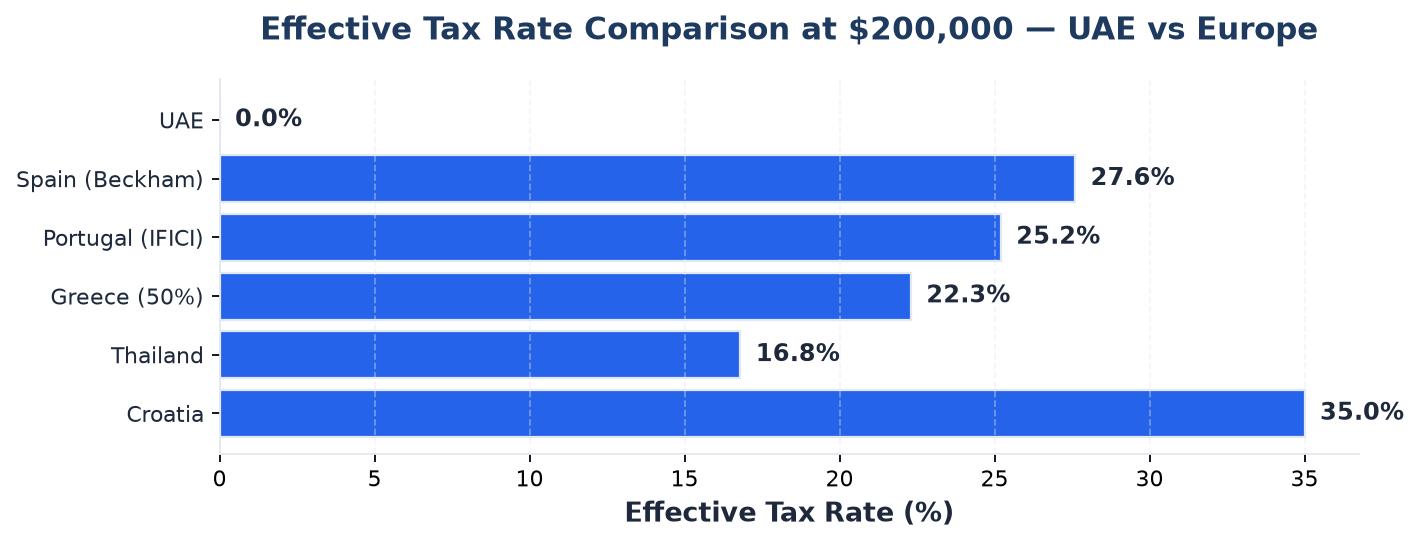
Who Actually Gets 0%?
Anyone who's a UAE tax resident. Tax residency requires:
- 183 days in the UAE in a calendar year, OR
- 90 days in the UAE if you have a permanent residence, employment, or business in the country
The 90-day rule is the one most nomads use. Get a UAE residence visa, a rental contract, and a bank account, spend 90 days there, and you're a tax resident. You can theoretically spend the other 275 days anywhere.
But — and this is the trap — your other country will also want to claim you. If you're a US citizen, the US taxes worldwide income regardless of residence. If you're from Germany, the German tax office will look at your "center of vital interests" — where your family lives, where your car is registered, where your kids go to school. Getting a UAE residence visa doesn't automatically break tax residency in your home country.
Breaking home-country tax residency is the hardest part of the UAE strategy. It requires:
- Actually moving your life (not just getting a visa)
- Spending less than 183 days in your home country
- Potentially deregistering from your home country's municipality
- Having no "permanent home" available to you in your home country
Every country defines tax residency differently. The UK uses a statutory residence test. Germany uses facts-and-circumstances. Australia uses a residency test based on domicile and ties. Get professional advice before attempting this — I've seen German freelancers get hit with 5-figure back-tax bills because they thought their Dubai rental contract was enough to break German residency. It wasn't.
The Remote Work Visa: $3,500/Month Barrier
The UAE's "Virtual Working Programme" (Dubai) and "Remote Work Visa" (federal) require:
- Proof of employment or business ownership outside the UAE
- Monthly income of at least $3,500 (approximately $42,000/year)
- Valid health insurance covering the UAE
- Passport with 6+ months validity
The visa costs about $287 for 1 year. Renewal is straightforward if you still meet the requirements. Processing takes 2-4 weeks through the official portals.
The income requirement of $3,500/month filters genuinely. It's higher than Thailand ($1,400), Indonesia (asset-based), and even Portugal ($3,040/month). The UAE wants remote workers who spend money, not backpackers with laptops.
The Corporate Tax Trap (It Probably Doesn't Apply to You)
The 9% corporate tax applies to businesses with annual profits above AED 375,000 ($102,000). Below that threshold, the rate is 0%. Small business relief exempts companies with revenue under AED 3 million ($817,000) entirely through 2026.
If you're a solo freelancer billing $80,000/year, you're not a "business" for UAE corporate tax purposes unless you've structured yourself as one. Freelance permits in UAE free zones (Dubai Internet City, Abu Dhabi's Twofour54, RAK Economic Zone) cost $1,500-3,000/year and don't trigger corporate tax for a solo operator.
If you operate through a UAE-registered free zone company billing more than $200,000/year, get an accountant. The corporate tax regime has exemptions and deductions that apply, but the paperwork needs to be correct. Filing corporate tax returns costs $2,000-5,000/year through a decent UAE accounting firm.
The Real Costs Nobody Talks About
"Tax-free" doesn't mean "free." Here's what you actually pay:
Emirate-level fees: Dubai charges a 5% housing fee (based on annual rent) and a "knowledge fee" of AED 10 ($2.70) on every government transaction. Small, but they add up. If your rent is $24,000/year, that's $1,200 in housing fees.
Social Security for Employees: If you're an employee of a UAE company, your employer pays 12.5% of your salary into the General Pension and Social Security Authority. This doesn't come out of your pocket directly, but it affects your total compensation package — UAE employers factor this into salary negotiations. For freelancers and self-sponsored remote workers: you don't pay this.
Health Insurance: Mandatory in Dubai and Abu Dhabi. A decent expat plan costs $1,500-4,000/year depending on age, coverage level, and pre-existing conditions. Emirates like Ras Al Khaimah are less strict but you need insurance for the visa anyway.
Cost of Living: Here's the reality at two different locations:
Dubai Marina/ Downtown: 1-bedroom $1,800-3,000/month, meal out $20-40, gym $80-150/month, car lease $400-600/month. Annual living costs run $35,000-50,000 for a comfortable lifestyle.
Ras Al Khaimah: 1-bedroom $600-900/month, meal out $8-15, gym $30-50/month. Annual living costs run $18,000-28,000. Half the cost of Dubai proper.
The tax savings need to exceed the lifestyle premium. At $80,000 income, you'd pay roughly $24,000 in taxes in Spain (30% effective). In Dubai, you pay $0 in taxes but $40,000 in living costs vs $30,000 in Barcelona. Net savings: $14,000. Add back the Dubai lifestyle premium and the gap narrows.
At $200,000 income, the math flips hard. $70,000+ in Spanish taxes vs $0 in UAE taxes. Even with Dubai's cost of living, you're saving $40,000-50,000/year. The UAE is designed for high earners.
Dubai vs Ras Al Khaimah: The Smart Play
RAK is the move most Dubai nomads don't know about. It's a 45-minute drive from Dubai, has mountains, beaches, and almost zero traffic. RAK Economic Zone (RAKEZ) offers freelance and business licenses at 60-70% of Dubai prices. The cost of living is genuinely half of Dubai's.
The RAK remote worker visa costs the same as Dubai's ($287), but everything else is cheaper. A 2-bedroom beachfront apartment in RAK: $800-1,200/month. Same apartment in Dubai Marina: $3,500-5,000/month.
RAK has enough infrastructure — good internet, a few coworking spaces, decent restaurants — but it's quiet. You'll drive to Dubai for nightlife, meetings, or airport access. The trade is $20,000-30,000/year in living costs for 45 minutes in the car when you need city amenities.
What I'd Actually Recommend
The UAE works as a tax base if you:
- Earn $100,000+/year (the tax savings justify the lifestyle cost)
- Can genuinely break tax residency in your home country (professional advice required)
- Want a Middle East hub for business travel to Asia, Africa, and Europe
- Don't mind heat (May-September is 40-45°C, you'll live indoors)
If you earn $50,000-80,000, the cost-of-living math makes the UAE break even at best compared to Portugal or Thailand. You might save 25% on taxes but spend 25% more on rent and food. The lifestyle has to be the draw, not the finances.
One thing I'll say: the UAE's banking infrastructure is genuinely excellent. You can open a multi-currency account (AED, USD, EUR, GBP) with Emirates NBD or Wio in 24 hours. Receiving international transfers is seamless. If you run a business with global clients, the UAE banking experience alone is worth something.
Don't come here thinking "zero tax = infinite savings." Come here if the lifestyle, location, and professional ecosystem make sense for your situation, with the tax advantage as a bonus. The people I know who succeeded in the UAE had clear business reasons to be there. The ones who came just for tax savings left within 18 months.
Calculate your tax in this country
Use the TaxEd Abroad calculator to see exactly what you would pay.
Try the calculatorRelated Articles
Thailand DTV Visa Tax Guide 2026: What Remote Workers Actually Pay
The Destination Thailand Visa explained — tax residency rules, what income is taxable, and how to minimize your Thai tax bill.
Digital Nomad Tax Comparison 2026: 7 Countries Head-to-Head
Spain vs Portugal vs Thailand vs Croatia vs UAE vs Greece vs Malaysia. Which country leaves the most money in your pocket?