Spain Digital Nomad Visa: Tax Guide 2026 (Beckham Law Explained)
How Spain's Digital Nomad Visa works, income requirements, and whether the Beckham Law 24% flat tax actually saves you money.

I've spent the last 3 years filing taxes in Spain as a remote worker, and let me be honest up front: Spain is a tax nightmare for anyone who walks in unprepared. But if you play your cards right — specifically, if you qualify for the Beckham Law — Spain can actually be cheaper than Portugal.
The catch? Most nomads don't qualify. And the ones who do often miss the application window. Let me break down exactly how this works in 2026.
The Spain Digital Nomad Visa: What You Actually Need
The Digital Nomad Visa (DNV) lets non-EU remote workers live in Spain for up to 3 years. The headline number everyone cites is €2,400/month in income — that's the minimum you need to show.
But the minimum won't cut it. Spanish consulates in 2026 are rejecting applicants who barely scrape the threshold. I've seen rejection letters from the Madrid consulate specifically calling out "insufficient economic guarantee" for people showing exactly €2,400. Aim for €3,000/month minimum if you want peace of mind.
The application itself has a quirk most guides don't mention: you have 3 months from the day you land to apply if you enter on a tourist visa, OR you can apply from your home country's Spanish consulate. The consulate route takes about 20-45 days. The in-country route can drag on for 3-4 months, during which you can't legally work. Factor that into your budget.
Here's what the paperwork looks like:
- Clean criminal record from every country you've lived in the past 5 years
- Private health insurance with no co-pays (Sanitas, Adeslas, or Mapfre — don't cheap out)
- Employment contract or client contracts showing you've been doing the work for at least 3 months
- Proof of professional qualifications (university degree OR 3+ years of experience)
The Beckham Law: Spain's Secret Weapon
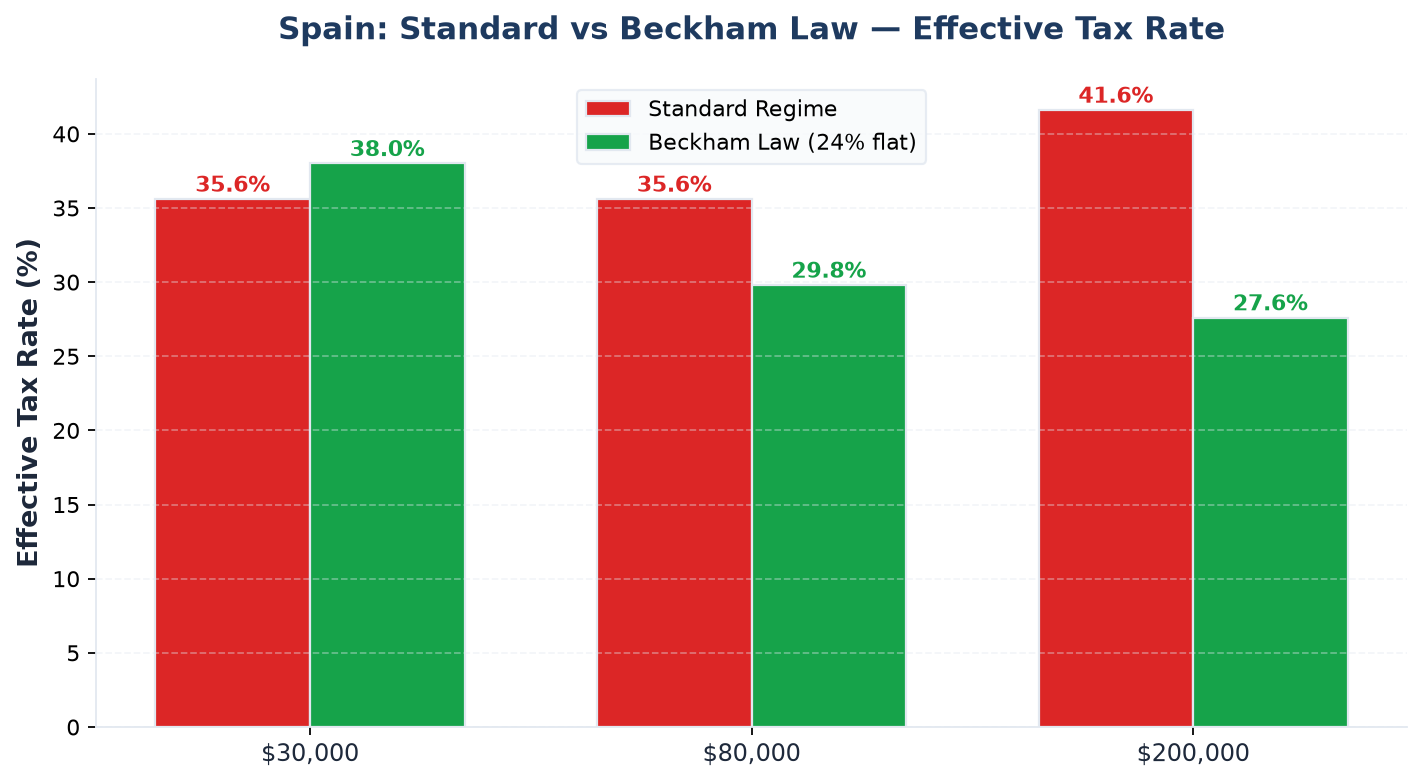
Spain charges progressive tax rates from 19% to 47%. At €60,000, you'd pay roughly €17,600 under the standard system — about 29.3% effective. That's brutal.
Enter the Beckham Law (officially "Régimen Especial de Trabajadores Desplazados"). If you're a new Spanish tax resident who hasn't lived in Spain for the previous 5 years, you can opt for a flat 24% tax on your Spanish-source income up to €600,000. Everything above €600,000 gets taxed at 47%.
Here's the important detail no one tells you: the Beckham Law only applies to employment income, not freelance income as many assume. If you're a freelancer invoicing clients, standard progressive rates apply even under Beckham. The DNV specifically allows both employment and freelance work, so your classification matters enormously.
The 2026 update added another wrinkle: Beckham Law now also covers digital nomads with a foreign employer — the 2023 Startup Law made this explicit. So if you work remotely for a US tech company and they pay you a salary, you're golden. If you freelance for 5 different clients through your own LLC, you're not.
At €60,000 of salary income under Beckham Law:
- Tax: €60,000 × 24% = €14,400
- Social security (autónomo): roughly €294/month × 12 = €3,528
- Total tax burden: €17,928 (29.9% effective)
At €60,000 under standard progressive:
- Tax: roughly €17,600
- Social security: same €3,528
- Total: €21,128 (35.2% effective)
Net difference: you save about €3,200/year with Beckham Law at €60K.
When Beckham Law Is Actually Worth It
Beckham Law shines at higher incomes. At €100,000:
- Beckham: €24,000 income tax + €3,528 social = €27,528 (27.5%)
- Standard: roughly €33,000 income tax + €3,528 social = €36,528 (36.5%)
You're saving nearly €9,000. The break-even point where Beckham clearly wins is around €45,000-50,000. Below that, the difference shrinks to maybe €1,500-2,000 — not nothing, but maybe not worth the extra paperwork burden.
And the paperwork burden is real. Beckham Law requires a separate application (Modelo 149), and Spanish tax authorities audit Beckham filers more aggressively. I know a developer in Valencia who got hit with a €4,200 penalty because he claimed Beckham on freelance income. The tax office caught it 2 years later.
The 6-Month Application Window
This is where people mess up. You must apply for Beckham Law within 6 months of your Social Security registration date in Spain. Not the date your visa starts. Not the date your residency card arrives. The Social Security registration date.
If you miss the window, you're stuck on progressive rates for the entire tax year. No appeal. No exceptions. I've watched it happen to 3 different nomads in Barcelona who "were going to get around to it."
The application (Modelo 149) asks for:
- Your NIE (foreigner ID number)
- Your employer's details or proof of self-employment
- A declaration that you haven't been a Spanish tax resident in the past 5 years
- Your Social Security number
Processing takes 1-2 months. During that time, your employer withholds at the standard progressive rate. Once approved, you get the excess refunded. Most people I know got their refund within 3 months.
Social Security: The Autónomo System
Spain charges self-employed workers through the RETA system. For 2026, the rates are progressive based on net income:
- Under €670/month net: €294/month
- €670-€900/month net: €294/month
- €960-€1,200/month net: €320/month
- Scales up to €1,470/month at the top tier
As a digital nomad making €60,000, you'll fall into roughly the €400-500/month bracket. Yes, that hurts. It's one of Europe's highest self-employment contributions.
The silver lining: these contributions count toward Spanish public healthcare and eventual pension. Whether a pension from a country you lived in for 5 years is worth it is a different conversation, but the healthcare access alone justified the cost for me. Spanish public healthcare is genuinely good — short wait times for specialists, excellent hospitals in major cities.
What I'd Actually Recommend
If you earn €50,000+ as an employee of a foreign company and you're eligible for Beckham Law, Spain is a solid tax play. Barcelona, Madrid, Valencia — all have thriving nomad communities, good infrastructure, and you'll pay roughly 28-30% all-in.
If you freelance or earn under €45,000, look elsewhere. Portugal's IFICI flat 20% beats Spain's progressive system at lower incomes. Croatia's flat-rate system might work better too.
The one thing I'd hammer home: run the actual numbers before you move. Spain's tax calculator on the AEAT website is accurate but only in Spanish. Third-party calculators exist — use them. The difference between paying 24% and 47% marginal is tens of thousands of euros over a 3-year visa.
And please — if you qualify for Beckham Law, file that Modelo 149 within 6 months. Set a calendar reminder. This is not the thing to procrastinate on.
Calculate your tax in this country
Use the TaxEd Abroad calculator to see exactly what you would pay.
Try the calculatorRelated Articles
Portugal IFICI Tax 2026: NHR Replacement for Digital Nomads
Portugal's IFICI (formerly NHR 2.0) offers a 20% flat tax for 10 years. Here's who qualifies and how to apply.
Digital Nomad Tax Comparison 2026: 7 Countries Head-to-Head
Spain vs Portugal vs Thailand vs Croatia vs UAE vs Greece vs Malaysia. Which country leaves the most money in your pocket?