Portugal IFICI Tax 2026: NHR Replacement for Digital Nomads
Portugal's IFICI (formerly NHR 2.0) offers a 20% flat tax for 10 years. Here's who qualifies and how to apply.

I moved to Portugal in 2022 specifically for the NHR tax regime, and then watched the government kill it in 2024. The replacement — IFICI (Incentivo Fiscal à Investigação Científica e Inovação) — is a different beast entirely. Narrower. Less generous. But still worth it for the right person.
Here's the honest breakdown after a year of watching people navigate the transition.
What IFICI Actually Is
IFICI is a 20% flat tax on Portuguese-source employment and self-employment income for workers in qualifying activities. It runs for 10 consecutive years from your first year of Portuguese tax residency.
Compare that to NHR, which offered 20% flat on a much broader set of professions AND 0% on most foreign-source income. IFICI is NHR's less fun, more serious sibling.
The qualifying activities list is the thing that disqualifies most applicants:
- Software development and IT
- Scientific research
- Engineering and architecture
- Higher education teaching
- Biotechnology
- Industrial design
If you're a software engineer, data scientist, cybersecurity specialist, or product designer, you qualify. If you're a content writer, marketing consultant, or virtual assistant, you don't. The tax office (AT) has gotten stricter about interpreting these categories in 2026. I've seen marketing managers get rejected despite job descriptions mentioning "analytics."
The D8 Visa: Your Entry Point
The D8 Digital Nomad Visa is Portugal's path for non-EU remote workers. Income requirement: €3,040/month for 2026. That's about €36,480/year — one of Europe's highest thresholds.
Documentation demand is significant:
- 6 months of bank statements showing consistent income
- Employment contract or service agreements
- Tax residency statement from your home country
- Portuguese NIF (tax number — get this first, before applying)
Processing times in 2026 range from 60 to 120 days at Portuguese consulates. The Lisbon AIMA office is still a mess — expect 4-6 months for the actual residency card after approval. You'll get a temporary document in the meantime that lets you travel within Schengen.
IFICI vs Standard: The Numbers
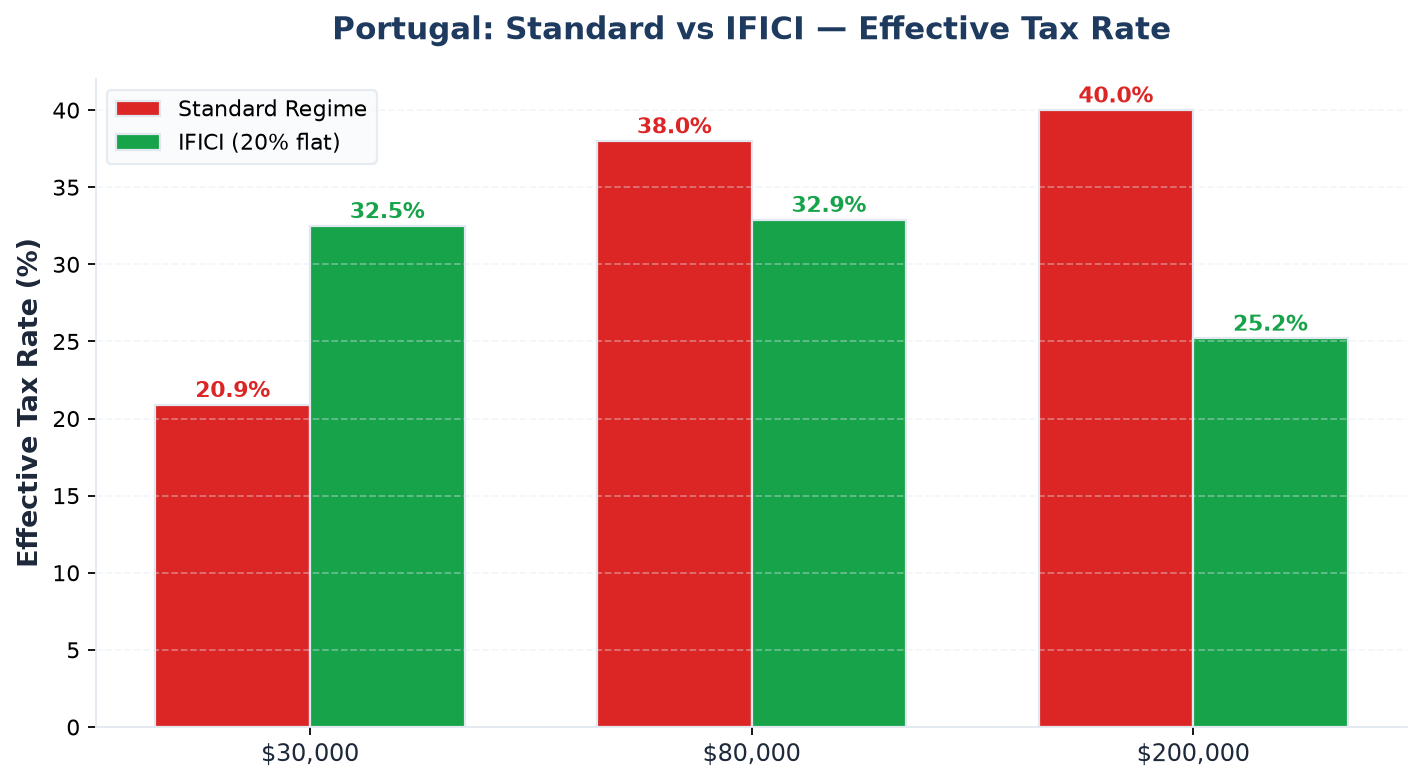
Here's the comparison that matters. Portugal's standard progressive rates run 13% to 48% in 2026:
At €40,000 income:
- Standard progressive: roughly €8,360 in taxes (20.9% effective)
- IFICI 20% flat: €8,000 exactly
- Difference: IFICI saves you €360. Barely anything.
At €80,000 income:
- Standard progressive: roughly €24,600 in taxes (30.8% effective)
- IFICI 20% flat: €16,000 exactly
- Difference: IFICI saves you €8,600. That's real money.
The crossover point where IFICI clearly wins is around €45,000-50,000. Below that, the standard rates are competitive enough that IFICI barely moves the needle.
Social security is separate. As a self-employed worker, you'll pay 21.4% of 70% of your relevant income — effectively about 15% of your total income. There's a monthly minimum of roughly €20 and a cap at €1,318/month. At €60,000 income, expect to pay around €750/month.
The 10-Year Problem
IFICI locks you in for 10 years once you start. That sounds great on paper — guaranteed low rate for a decade. But here's what nobody talks about:
Portugal's political landscape is unstable. The Socialist government that introduced IFICI could lose to a center-right coalition tomorrow. Tax regimes get modified, "grandfathered in" protections get tested in courts, and the tax authority gets aggressive when budgets need balancing.
I'm not saying IFICI will be revoked retroactively — that would violate EU principles. But I am saying 10 years is a long time, and I've seen Portugal change tax rules mid-stream before. The NHR phase-out, for instance, had a transition period that left many people in limbo.
Can You Combine IFICI With Foreign Income?
This is the big downgrade from NHR. Under NHR, most foreign-sourced income (dividends, royalties, rental income from abroad) was tax-exempt. Under IFICI, you're taxed at standard progressive rates on that foreign income.
If you have significant dividend income from investments, Portugal under IFICI is worse than it was under NHR. A UK resident with £20,000 in dividends would have paid 0% under NHR; now they're looking at 28% (Portugal's standard dividend rate).
The exception: if that foreign income is derived from your qualifying IFICI activity and taxed at source, double tax treaties apply. Portugal has treaties with 79 countries, so there's usually a credit mechanism.
What I'd Actually Do
Portugal at IFICI rates works best for tech workers earning €55,000+. Below that, the administrative hassle and high social security contributions eat into the tax savings. The D8 visa income requirement of €3,040/month already filters out lower earners.
The real advantage of Portugal isn't just the tax rate — it's the 10-year predictability. In Spain, your Beckham Law expires after 6 years and you're dumped into the 47% bracket. In Portugal, you've got a full decade to plan around a 20% rate.
Lisbon is expensive now (€1,200-1,600 for a 1-bedroom), but Porto, Braga, and the Algarve still offer decent value. If I were starting fresh in 2026, I'd pick Braga — 40 minutes from Porto, good infrastructure, rents around €600-800, and the tech scene is growing fast enough that you won't feel isolated.
The one thing I can't overstate: get a Portuguese accountant who specializes in IFICI. Not a general accountant. Not a lawyer who "also does taxes." Someone who files IFICI applications weekly. The system has too many edge cases, and AT's rejection rate for self-filed applications is around 30% according to the accountant I use in Porto.
Calculate your tax in this country
Use the TaxEd Abroad calculator to see exactly what you would pay.
Try the calculatorRelated Articles
Spain Digital Nomad Visa: Tax Guide 2026 (Beckham Law Explained)
How Spain's Digital Nomad Visa works, income requirements, and whether the Beckham Law 24% flat tax actually saves you money.
Croatia Digital Nomad Visa: Tax Guide 2026
Croatia's digital nomad visa is one of Europe's most popular. Here's what the 20-30% income tax actually looks like.