Croatia Digital Nomad Visa: Tax Guide 2026
Croatia's digital nomad visa is one of Europe's most popular. Here's what the 20-30% income tax actually looks like.

Croatia was the first EU country to create a digital nomad visa, back in January 2021, and they've been quietly iterating on it ever since. The tax system is unusual — it's not quite flat, not quite progressive, and the social security bite is bigger than most people budget for. Here's what 2026 looks like.
The Croatia Digital Nomad Visa
The Croatian Digital Nomad Visa lets non-EU remote workers stay for 1 year (with the option to reapply after 6 months outside the country). The income threshold is €2,539.47/month, or €30,473.64/year. It's not random — it's pegged to a specific percentage of the Croatian average salary, and the number changes annually.
Documentation requirements:
- Valid passport
- Proof of remote work (employment contract or business registration)
- Bank statements for the past 6 months
- Clean criminal record from your home country
- Croatian health insurance (private plan, roughly €400-600/year)
- Proof of accommodation in Croatia (rental contract)
The visa is processed at Croatian police stations in-country if you enter visa-free, or at Croatian embassies abroad. Processing time is typically 2-4 weeks. The temporary residence permit that accompanies it takes another 30-45 days.
One-year duration is the biggest limitation. In Spain, you get 3 years. In Portugal, 2 years (extendable). Croatia gives you 12 months and then you have to leave the Schengen Area. After 6 months outside Croatia, you can apply again. This makes Croatia a good "gap year" destination but not a long-term base.
The Tax System: Flat But Not Really
Croatia's tax system looks flat at first glance but actually has two tiers:
- Up to €50,400/year (420,000 HRK equivalent): 20% income tax
- Above €50,400/year: 30% income tax
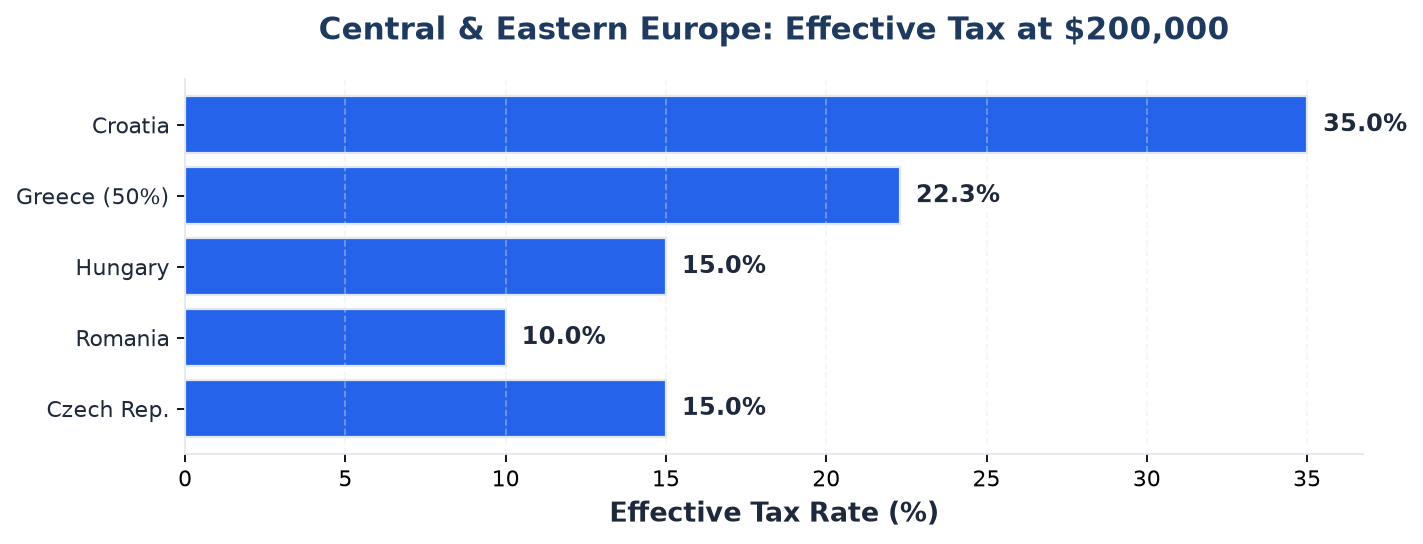
Plus a local surtax that varies by municipality. Zagreb charges 18%, so the effective rates in Zagreb are 23.6% and 35.4%. Split charges 10%. Dubrovnik charges 12%. Small towns often charge 0%.
At €40,000 in Zagreb: you'd pay 20% on the entire amount = €8,000 + 18% surtax = €9,440 total (23.6% effective). In a town with 0% surtax, it's a straight €8,000 (20% effective).
At €60,000 (split between tiers): 20% on €50,400 = €10,080 + 30% on €9,600 = €2,880. Total: €12,960 + 18% Zagreb surtax = €15,293 (25.5% effective). In a surtax-free location: €12,960 (21.6% effective).
The surtax trick matters enormously. Living in Dalmatia (Split area) instead of Zagreb saves you real money. A €60,000 income in Split pays roughly €14,256 (23.8% effective) vs €15,293 in Zagreb. That's a €1,037 difference — enough for a month's rent.
Social Security: The Part Nobody Budgets For
Here's the Croatian catch. Health insurance and social security contributions for self-employed digital nomads run roughly 20% of your income base. This includes:
- Pension insurance (pillar I): 15% of the base
- Pension insurance (pillar II): 5% of the base
- Health insurance contribution: about 7.5%
The "base" is set by the tax authority and adjusted annually. For 2026, full contributions apply on income up to roughly €55,000/year. Above that, the ceiling caps contributions.
At €40,000 with full contributions: roughly €8,000 in social costs (20%). Combined with 20% income tax (€8,000), your total tax burden hits €16,000 — a 40% effective rate. That's worse than Spain under standard progressive.
At €60,000 with full contributions: roughly €11,000 in social costs (capped near the ceiling). Combined with income tax, you're looking at roughly €26,000 total (43.3% effective).
This is the thing that makes Croatia expensive despite the "low" 20% headline rate. Social security adds 20 points to your effective burden. Compare that to Thailand where social security is ฿300/month, and you understand why European countries deliver more services but cost dramatically more.
The EU Advantage
Croatia joined the Eurozone and Schengen in January 2023. This matters for three practical reasons:
First, Schengen means no border checks when traveling to Italy, Slovenia, Austria, or anywhere else in the zone. Weekend trips to Venice or Ljubljana are trivial — you're 2-3 hours by car from amazing destinations.
Second, time spent in Croatia counts toward EU long-term residency in some member states. If you spend 5 years in Croatia as a legal resident (which requires renewing/stacking visas), you may qualify for EU permanent residency. The rules vary and Croatia has tighter interpretations than some Western EU countries, but the path exists.
Third, Croatian bank accounts are Eurozone bank accounts. SEPA transfers, no currency conversion fees for Euro transactions, and access to the same banking infrastructure as Germany or France. This simplifies receiving client payments from EU customers.
Croatia vs Portugal vs Greece
If you're choosing between these three countries:
Portugal IFICI (20% flat): wins for tech workers earning €55,000+. The IFICI 20% flat is better than Croatia's 20-30% with surtax, and Portugal's social security at roughly 15% is lower than Croatia's 20%. Portugal gives you a 10-year runway vs Croatia's 1 year.
Greece (new resident 50% reduction): wins for the first 2 years if you qualify for the 50% income deduction. A Greek resident earning €60,000 pays tax on only €30,000, pushing them into lower progressive brackets. But Greece's DNV requires €3,500/month ($42,000/year) — higher than Croatia's threshold.
Croatia: wins for shorter stays, people who want Schengen access, and those earning under €50,400 (clear 20% bracket). The lifestyle trade-off is real — Croatia's Dalmatian coast offers a quality of life that rivals anywhere in Europe at prices that still beat Lisbon and Barcelona.
What I'd Actually Do
Croatia makes sense as a 1-year base if you:
- Earn between €35,000-50,000 (staying in the 20% bracket)
- Live outside of Zagreb (surtax difference)
- Want Schengen mobility
- Accept the high social security as the price of EU infrastructure
I wouldn't set up in Croatia as a long-term tax strategy. The social security burden makes it worse than Portugal or Spain for anyone earning above median, and the 1-year visa creates too much uncertainty. But for a beautiful year working from Split or Dubrovnik, with EU banking and travel, it's hard to beat.
Three practical tips:
- Register in a municipality with 0% surtax if you can. Samobor (20 minutes from Zagreb) and many Istrian towns have zero surtax.
- The private health insurance requirement for the visa covers you, but it's basic. Budget another €1,000/year for a supplementary plan if you have any medical needs.
- Croatian bureaucracy is slower than you expect. The tax authority (Porezna uprava) can take 3-6 months to issue your OIB (tax ID number). Start this process the week you get your visa.
Calculate your tax in this country
Use the TaxEd Abroad calculator to see exactly what you would pay.
Try the calculatorRelated Articles
Portugal IFICI Tax 2026: NHR Replacement for Digital Nomads
Portugal's IFICI (formerly NHR 2.0) offers a 20% flat tax for 10 years. Here's who qualifies and how to apply.
Greece Digital Nomad Visa Tax 2026: New Rules Explained
Greece offers a 7% flat tax on foreign income and a 50% income reduction for new residents. But there's a catch.