Greece Digital Nomad Visa Tax 2026: New Rules Explained
Greece offers a 7% flat tax on foreign income and a 50% income reduction for new residents. But there's a catch.

Greece introduced its Digital Nomad Visa in late 2021 and has been tweaking the tax rules every year since. The 2026 landscape offers a genuine tax advantage for new residents — but the 7% flat tax option that headlines make sound amazing has a half-million-euro catch most people miss.
The Greece Digital Nomad Visa
The DNV requires €3,500/month in income ($42,000/year) — one of Europe's highest thresholds. Greece wants high-spending nomads and their pricing reflects it.
Visa duration: 1 year initially, renewable for up to 2 more years (3 years total). After 3 years, you can apply for a residence permit if you've actually been living there. The application goes through Greek consulates abroad — you can't apply from within Greece on a tourist visa.
Requirements:
- €3,500/month income (single applicant), increases by 20% for a spouse and 15% per child
- Remote work contract or business registration
- Clean criminal record
- Health insurance valid in Greece
- Accommodation in Greece (rental contract or ownership)
Processing typically takes 4-8 weeks at major consulates (London, New York, Berlin). Smaller consulates can take 3-4 months. Greek bureaucracy is legendary for a reason — budget patience into your timeline.
The Standard Tax System: Progressive 9-44%
Greece charges progressive income tax:
- 0-€10,000: 9%
- €10,001-€20,000: 22%
- €20,001-€30,000: 28%
- €30,001-€40,000: 36%
- Above €40,000: 44%
Solidarity contribution (effectively an extra tax): 0% up to €12,000, 2.2% from €12,001-€20,000, scaling to 10% above €220,000. This was supposed to be temporary when introduced in 2011. It's still here in 2026.
At €40,000 income:
- Tax: 9% on €10K (€900) + 22% on €10K (€2,200) + 28% on €10K (€2,800) + 36% on €10K (€3,600) = €9,500
- Solidarity: 2.2% on €8K + 5% on €20K = roughly €1,460
- Total: €10,960 (27.4% effective)
At €60,000:
- Tax: €9,500 (first €40K) + 44% on €20K (€8,800) = €18,300
- Solidarity: roughly €2,900
- Total: €21,200 (35.3% effective)
Greece is expensive at the high end. The 44% top bracket kicks in fast — much faster than Spain's system, where the 47% bracket starts at €300,000.
The 50% Income Reduction for New Residents
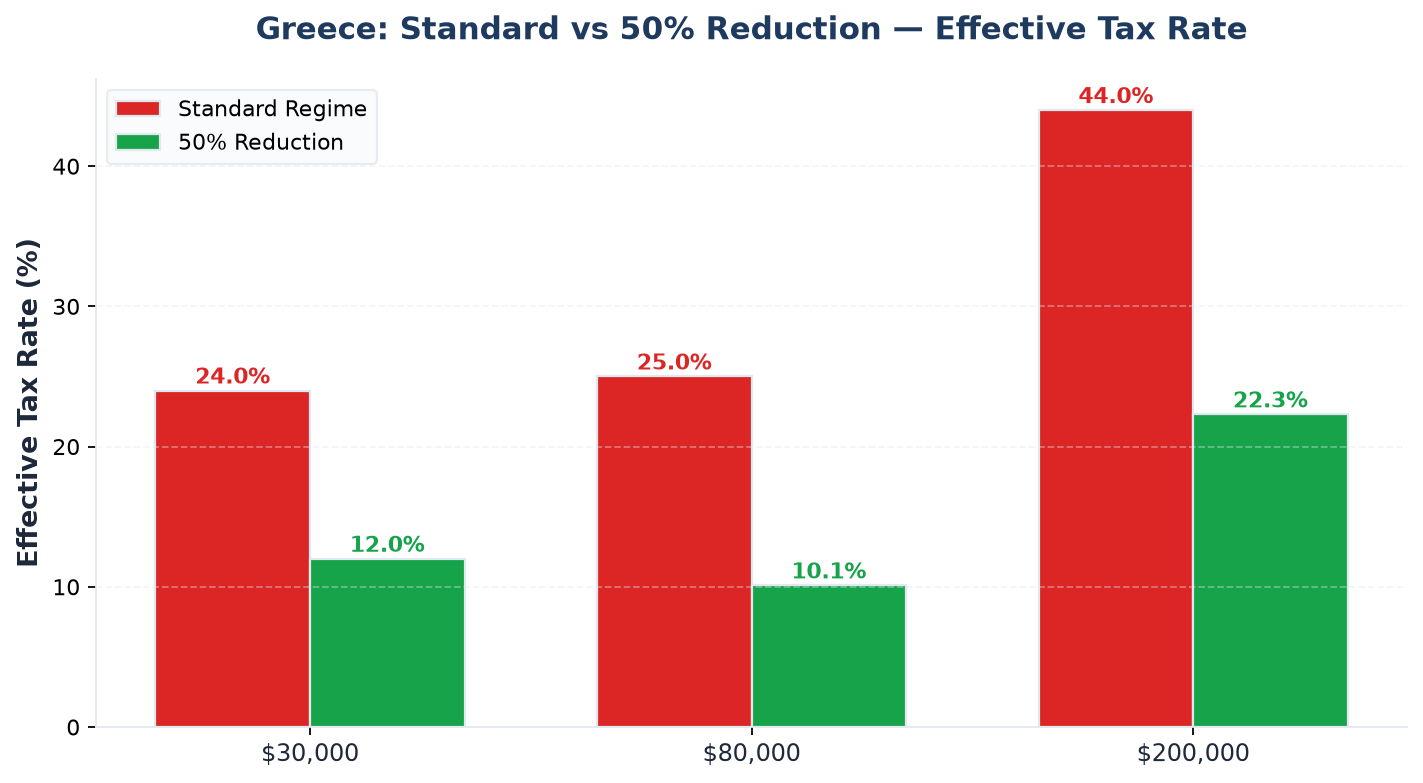
This is Greece's real incentive for digital nomads. If you transfer your tax residence to Greece and haven't been a Greek tax resident for 5 of the previous 6 years, you can deduct 50% of your employment or business income for up to 7 years.
At €60,000 with the 50% reduction: your taxable income drops to €30,000.
- Tax: 9% on €10K + 22% on €10K + 28% on €10K = €5,900
- Solidarity on €30K: roughly €1,000
- Total: €6,900 (11.5% effective)
That's a dramatic difference. From €21,200 to €6,900. A €14,300 annual saving for 7 years.
The qualifying criteria matter:
- You must be an employee or self-employed professional
- The income must come from work you actually perform in Greece
- You must not have been a Greek tax resident in any 5 of the preceding 6 years
- The employer or client must be based abroad (if employment income)
The 50% reduction is genuinely one of Europe's best tax incentives for new residents. At €60,000-100,000, it pushes your effective rate into the 11-14% range — competitive with anything outside the UAE.
The 7% Flat Tax: With a €500,000 Catch
The "alternative taxation for foreign pensioners and investors" offers a flat 7% on foreign-source income. It's available to people who transfer their tax residence to Greece AND invest at least €500,000 in Greek real estate, businesses, or government bonds.
€500,000 is the entry ticket. Not €50,000. Not something you can negotiate. Half a million euros.
This regime makes sense for retirees with significant foreign pensions and capital — if you're pulling €100,000/year in pension income from multiple countries, paying €7,000 instead of €27,000 is compelling. But for a digital nomad making €60,000/year, you'd be spending €500,000 to save roughly €14,000/year in taxes. That's a 2.8% return on your investment, assuming stable tax policy for decades.
The 7% regime runs for 15 years. If you have the capital and the plan to stay in Greece long-term, the math can work. If you're a typical nomad with $80,000 in savings and a laptop, the 50% income reduction is your tool — not this.
Social Security and Other Costs
Self-employed workers pay social security through EFKA (the Unified Social Security Fund). For new professionals in their first 5 years: €150/month base contribution. After 5 years: the contribution scales up based on declared income, typically reaching €250-450/month.
At the €150/month introductory rate, annual social security is €1,800. At the standard self-employed rate (roughly 27% of declared income, capped): expect €6,000-8,000/year on a €60,000 income after the introductory period ends.
Self-employed professionals also pay a "business tax" (τέλος επιτηδεύματος) of €400-650/year depending on location. Small but irritating.
Greece charges an annual property tax (ENFIA) if you own real estate. As a renter, you avoid this entirely.
Greece vs Portugal vs Croatia
Here's how the numbers actually compare at €60,000:
Greece (50% reduction, year 1-7): about €6,900 income tax + €1,800 social (introductory rate) = €8,700 (14.5% effective). After 5 years when social security increases: €6,900 + €6,500 = €13,400 (22.3% effective).
Portugal IFICI (20% flat): €12,000 income tax + roughly €9,000 social = €21,000 (35% effective). Higher because social security is steeper.
Croatia (Split, 10% surtax): €14,256 income tax + €12,000 social = €26,256 (43.8% effective). Croatia's social security burden drags it down.
Greece wins the tax comparison for the first 7 years, assuming the 50% reduction applies. After that, Portugal catches up if you're still on IFICI at 20%.
The trade-off is infrastructure and bureaucracy. Portugal has better digital government services — you can do most things online. Greece still requires in-person visits for many tax and residency processes. The tax authority (AADE) is improving its online platform, but it's not where Portugal's Finanças portal is.
What I'd Actually Recommend
If you qualify for the 50% reduction and earn €40,000-90,000, Greece is underrated. The effective tax rate in your first 7 years beats almost everything in the EU except specialized regimes like the Beckham Law at higher incomes.
The visa threshold of €3,500/month filters entry, but if you clear it, the tax math works. Athens and Thessaloniki offer affordable city living (€500-700/month for a decent apartment). Greek islands get expensive but mainland Greece is genuinely cheap by Western European standards.
The downsides are real: Greek bureaucracy tests your patience, the economy is still recovering, and the tax rules change more frequently than other EU countries. The 50% reduction isn't at risk politically — it's well-established — but I'd watch for changes to social security rates and the solidarity contribution.
Three things to do before committing:
- Get a Greek accountant in your first month. The tax system has quirks that cost thousands if you self-navigate. A good accountant in Athens costs €600-1,200/year.
- Apply for the 50% income reduction when you file your first tax return, not before. The application window aligns with annual tax filings in April-June.
- Budget for the social security increase after year 5. The jump from €150/month to €400-500/month catches people off guard.
Calculate your tax in this country
Use the TaxEd Abroad calculator to see exactly what you would pay.
Try the calculatorRelated Articles
Croatia Digital Nomad Visa: Tax Guide 2026
Croatia's digital nomad visa is one of Europe's most popular. Here's what the 20-30% income tax actually looks like.
Spain Digital Nomad Visa: Tax Guide 2026 (Beckham Law Explained)
How Spain's Digital Nomad Visa works, income requirements, and whether the Beckham Law 24% flat tax actually saves you money.